Powered Anode Rods: What They Are and Why We Recommend Them
Explore the benefits of powered anode rods, including eliminating sulfur smells, reducing maintenance needs, and offering long-term corrosion protection for your water heater.
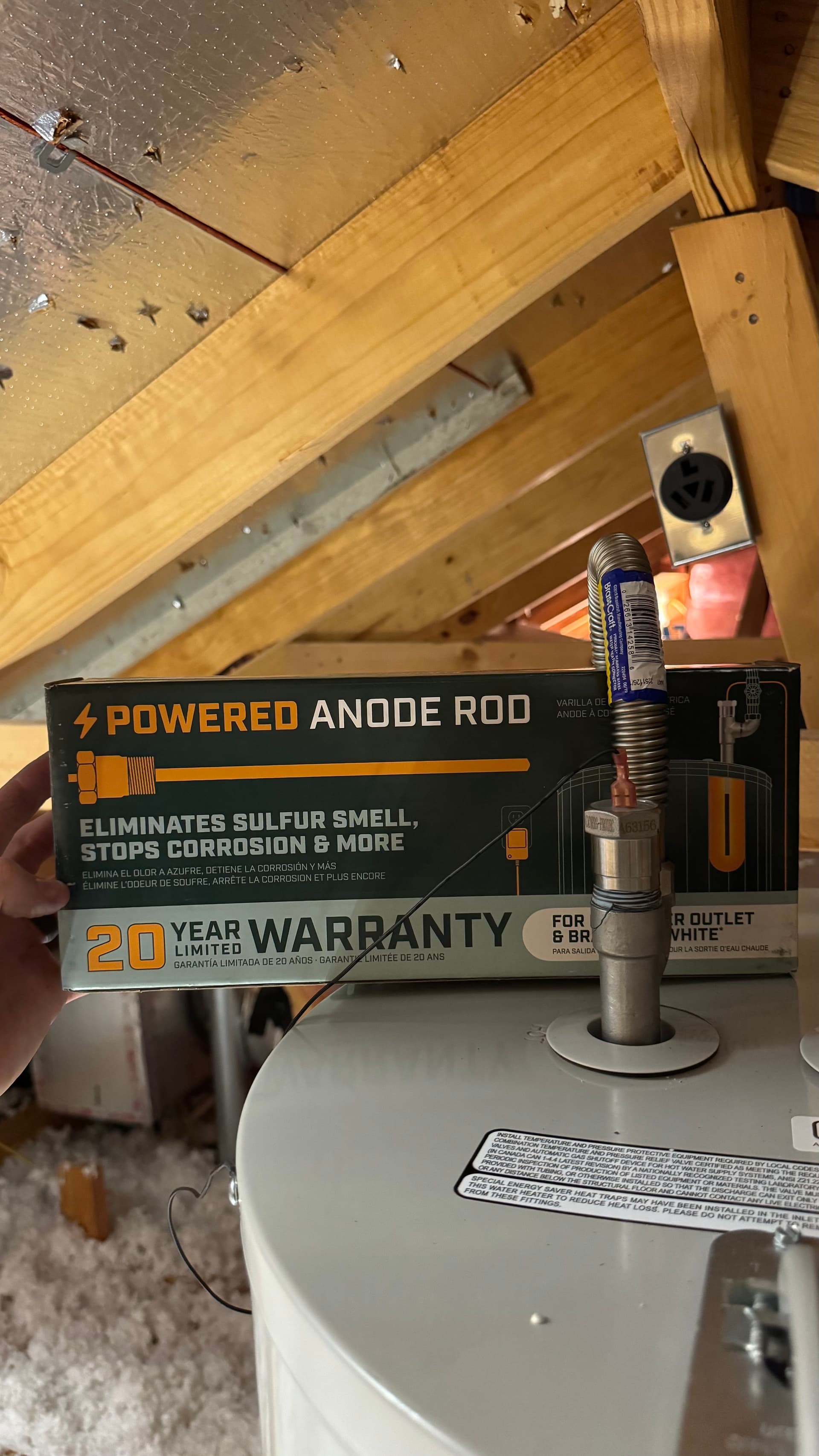
Powered Anode Rods: What They Are, How They Work, and Why We Recommend Them
Most homeowners know their water heater has a thermostat.
Many know it has heating elements or a burner.
Very few know there is a component inside the tank whose primary job is to prevent the water heater from rusting out.
That component is called the anode rod.
In fact, the anode rod is one of the most important parts of a water heater and one of the most overlooked.
At Plunger Pros, we regularly find homeowners who have never heard of an anode rod, don't know it exists, and have no idea that it needs maintenance or replacement.
Unfortunately, once a traditional anode rod is depleted, the water heater loses one of its primary defenses against corrosion.
That's why we often recommend upgrading to a powered anode rod.
Powered anode rods can help eliminate sulfur smells, reduce maintenance, and provide long-term protection for your water heater without the need for periodic replacement.
Let's look at how they work and why they've become one of our favorite water heater upgrades.
What Is an Anode Rod?
Every tank-style water heater contains an anode rod installed by the manufacturer.
The rod is inserted through the top of the water heater and extends down into the tank.
Its purpose is simple:
Protect the water heater from corrosion.
Without an anode rod, the steel tank would begin corroding much sooner and the lifespan of the water heater would be significantly reduced.
The anode rod acts as a sacrificial component.
Rather than allowing the tank itself to corrode, the anode rod attracts the corrosive activity and slowly deteriorates over time.
In other words:
The rod sacrifices itself to protect the tank.
What Are Traditional Anode Rods Made Of?
Most traditional anode rods are made from:
Magnesium
Aluminum
Aluminum/Zinc blends
Each material has advantages and disadvantages, but they all function the same way.
They gradually break down over time while protecting the tank.
This process is completely normal.
The problem is that many homeowners don't realize these rods eventually need replacement.
What Happens When an Anode Rod Is Used Up?
Once the anode rod is depleted, it can no longer protect the water heater.
At that point, the water heater tank itself becomes the next target for corrosion.
This is often where problems begin.
Common issues include:
Internal tank corrosion
Reduced water heater lifespan
Premature tank leaks
Rust-related failures
Once the tank itself begins leaking, replacement is typically the only option.
This is one reason regular water heater maintenance is so important.
Why Most Homeowners Never Replace Their Anode Rod
The reality is simple.
Most homeowners don't know anode rods exist.
Because they don't know the rod is there, they don't know it needs maintenance.
As a result:
The rod deteriorates
Protection disappears
Corrosion begins
The tank eventually leaks
Many water heaters fail with their original anode rod still installed because nobody ever knew it needed attention.
What Is a Powered Anode Rod?
A powered anode rod replaces the traditional sacrificial anode rod inside the water heater.
Unlike traditional rods that are made of magnesium or aluminum and slowly deteriorate over time, a powered anode rod uses a small electrical current to protect the tank from corrosion.
Instead of sacrificing itself, it continuously provides protection through an impressed current system.
This means:
The rod does not get consumed
The rod does not require periodic replacement
The tank remains protected long term
Think of it as a modern upgrade to one of the most important components in your water heater.
How Does a Powered Anode Rod Work?
Traditional anode rods work by attracting corrosive activity and sacrificing themselves.
Powered anode rods take a different approach.
Using a low-voltage electrical current, the rod actively prevents corrosion from occurring inside the tank.
Because the rod itself is not being consumed, it can continue protecting the tank for many years without replacement.
This is why many powered anode rod manufacturers offer extremely long warranties.
Why We Recommend Powered Anode Rods
There are several reasons we frequently recommend powered anode rods to homeowners throughout New Braunfels, San Antonio, Bulverde, Spring Branch, Canyon Lake, Schertz, Cibolo, and surrounding communities.
They Don't Need Periodic Replacement
This is probably the biggest advantage.
Traditional anode rods eventually wear out.
Powered anode rods do not.
That means:
Less maintenance
Fewer service calls
No recurring replacement costs
Once installed, homeowners can enjoy long-term protection without worrying about the rod deteriorating.
They Help Eliminate Sulfur Smells
One of the most common reasons homeowners call us about anode rods is because of a rotten egg smell coming from the hot water.
This odor is often caused by interactions involving the traditional anode rod and naturally occurring bacteria in the water.
The result is hydrogen sulfide gas, which creates the familiar sulfur smell.
Powered anode rods eliminate the traditional sacrificial rod and often eliminate the odor as well.
For homeowners dealing with persistent sulfur smells, this can be a game changer.
They Help Extend Water Heater Life
Because the tank remains protected from corrosion, powered anode rods can help maximize the lifespan of the water heater.
While no component can guarantee a tank will never fail, maintaining proper corrosion protection is one of the best ways to protect your investment.
Why Soft Water Changes the Conversation
One thing many homeowners don't realize is that water softeners can affect anode rod lifespan.
At Plunger Pros, we've consistently observed that traditional anode rods tend to deteriorate faster in homes with water softeners than in homes without them.
This is important because nearly every homeowner in our area either already has a water softener or is considering one.
As a result:
Traditional rods often need replacement sooner
Maintenance becomes more important
Powered anode rods become even more attractive
Since powered anode rods don't sacrifice themselves, they eliminate this concern entirely.
Powered Anode Rods and Hard Water
Hard water is one of the biggest challenges facing water heaters in Central Texas.
The combination of:
Hard water
Water softeners
Mineral buildup
High water usage
creates conditions where water heater maintenance becomes especially important.
A powered anode rod helps address one of the major maintenance items associated with protecting the tank.
A Real Customer Example From Bulverde
We recently worked with a homeowner in Bulverde who was experiencing a strong sulfur smell, but only from the hot water.
The homeowner had already hired another company.
That company replaced the original anode rod with an aluminum/zinc anode rod, which is a common recommendation for sulfur smell issues.
Initially, the solution appeared to work.
The odor disappeared.
However, several months later the sulfur smell returned.
The homeowner contacted Plunger Pros for another evaluation.
After reviewing the situation, we recommended replacing the existing anode rod with a Corro-Protec powered anode rod.
Once installed, the sulfur smell disappeared again.
More importantly, it stayed gone.
This is one of many examples where a powered anode rod provided a more permanent solution than repeatedly replacing traditional rods.
When Should You Consider Installing a Powered Anode Rod?
There are several situations where a powered anode rod makes sense.
During a New Water Heater Installation
This is one of the best opportunities.
Installing a powered anode rod at the beginning allows the tank to receive long-term protection from day one.
It is also typically easier and more cost-effective to install during the water heater replacement process.
After Installing a Water Softener
Because soft water tends to consume traditional anode rods faster, many homeowners choose to upgrade shortly after installing a water softener.
If You Have Sulfur Smells
If your hot water smells like rotten eggs, a powered anode rod may provide a long-term solution.
During Water Heater Maintenance
If inspection reveals the existing anode rod is nearing the end of its life, upgrading to a powered anode rod can eliminate future replacement concerns.
Do Powered Anode Rods Work in Gas and Electric Water Heaters?
Yes.
Powered anode rods can be installed in both:
Gas water heaters
Electric water heaters
The primary requirement is having an electrical outlet located within approximately six feet of the water heater.
The unit uses a small amount of electricity to operate the corrosion protection system.
Which Powered Anode Rod Do We Recommend?
At Plunger Pros, we primarily install:
Corro-Protec Powered Anode Rods
We've installed them for years and have had excellent results.
Some of the reasons we like them include:
Proven reliability
Long track record
Availability
Strong manufacturer support
20-year warranty
Because we regularly stock them, we're often able to install them during routine service visits and water heater maintenance appointments.
Is a Powered Anode Rod Worth It?
For many homeowners, the answer is yes.
When you compare the benefits:
Longer tank protection
Less maintenance
No recurring rod replacement
Sulfur smell elimination
Potentially longer water heater life
a powered anode rod can be one of the most cost-effective upgrades available for a tank-style water heater.
Especially in areas like New Braunfels and San Antonio where hard water is a constant challenge.
Protect Your Water Heater Before Problems Start
Most water heater failures don't happen overnight.
They occur gradually as components wear, maintenance is skipped, and corrosion takes its toll.
A powered anode rod is one of the simplest ways to help protect one of the most expensive plumbing appliances in your home.
If you're interested in upgrading your water heater, eliminating sulfur smells, or learning whether a powered anode rod is right for your system, Plunger Pros can help.
We provide water heater maintenance, powered anode rod installation, water softener installation, water heater replacement, and water quality solutions throughout New Braunfels, San Antonio, Schertz, Cibolo, Bulverde, Spring Branch, Canyon Lake, and surrounding communities.
Plunger Pros
Plumbing done the proper way
M45279
(830) 356-2141
Frequently Asked Questions
What does a powered anode rod do?
A powered anode rod protects the inside of a water heater tank from corrosion using a low-voltage electrical current.
How is a powered anode rod different from a traditional anode rod?
Traditional anode rods sacrifice themselves and eventually wear out. Powered anode rods do not deteriorate and continue providing protection long term.
Can a powered anode rod eliminate rotten egg smells?
In many cases, yes. Powered anode rods are commonly used to address sulfur odors originating from hot water systems.
Do powered anode rods work in gas water heaters?
Yes, provided there is an electrical outlet available nearby.
Do powered anode rods work in electric water heaters?
Yes.
Do I still need to replace a powered anode rod?
No. Unlike traditional anode rods, powered anode rods are not consumed during operation.
Does a water softener affect anode rod lifespan?
Yes. Traditional anode rods often deteriorate faster in homes with softened water.
What powered anode rod does Plunger Pros recommend?
We typically install Corro-Protec powered anode rods because of their reliability, performance, and 20-year warranty.