Tankless Water Heater Maintenance: Why It's Important and How Often It Should Be Done
Discover the importance of tankless water heater maintenance and how often it should be done for peak performance.
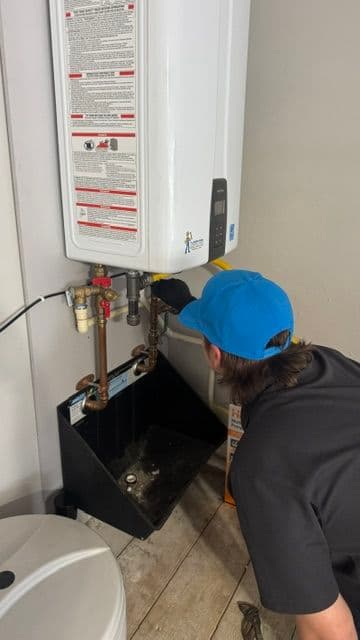
Tankless Water Heater Maintenance: Why It's More Important Than Most Homeowners Realize
One of the biggest selling points of a tankless water heater is its ability to provide endless hot water while using less energy than a traditional tank water heater.
Unfortunately, many homeowners are led to believe that "tankless" means "maintenance free."
That simply isn't true.
In fact, regular maintenance is one of the most important factors in determining how long a tankless water heater will last and how well it will perform.
At Plunger Pros, we regularly service tankless water heaters throughout New Braunfels, San Antonio, Schertz, Cibolo, Bulverde, Spring Branch, Canyon Lake, and surrounding communities. One of the most common issues we encounter is a lack of maintenance, especially in homes with hard water.
The good news is that many tankless water heater problems can be prevented with routine service.
Let's discuss why tankless water heater maintenance is important, what happens when it's neglected, and how often your system should be serviced.
Do Tankless Water Heaters Require Maintenance?
Yes.
Every major tankless water heater manufacturer recommends routine maintenance.
Most manufacturers recommend flushing the system at least once per year.
In our area, we often recommend:
Homes With a Water Softener
Flush once per year.
Homes Without a Water Softener
Flush twice per year.
The reason comes down to one thing:
Hard Water
Central Texas has some of the hardest water in the country, and hard water is one of the biggest threats to a tankless water heater.
Why Hard Water Is So Hard on Tankless Water Heaters
To understand why maintenance is important, it helps to understand how a tankless water heater works.
Inside the unit is a heat exchanger.
This heat exchanger contains a series of small pipes that coil back and forth through a heating chamber.
As water flows through the system, it passes through these pipes and is heated to the desired temperature before reaching your fixtures.
Unlike a traditional water heater that stores hot water in a tank, a tankless water heater heats water on demand.
The problem is that heating water causes calcium and magnesium minerals to separate from the water.
Those minerals then begin accumulating inside the heat exchanger.
Over time, the buildup becomes thicker and thicker.
This process is called:
Scale Buildup
And it is one of the primary reasons tankless water heaters require maintenance.
What Happens If a Tankless Water Heater Is Not Maintained?
As scale accumulates inside the heat exchanger, several problems begin developing.
Reduced Water Flow
The buildup narrows the inside diameter of the heat exchanger pipes.
As the opening becomes smaller, less water can flow through the system.
This can cause:
Reduced fixture flow
Lower water pressure
Inconsistent operation
Reduced Heating Performance
As scale thickens, it acts as insulation between the heating source and the water.
The system must work harder to achieve the desired water temperature.
This can result in:
Inconsistent hot water
Reduced efficiency
Increased operating costs
Error Codes
Many modern tankless water heaters monitor operating conditions and will display error codes when performance issues are detected.
Scale buildup is a common cause of:
Overheating errors
Flow-related errors
Temperature-related errors
Temperature Fluctuations
One of the most common complaints we hear is:
"The water gets hot, then cold, then hot again."
This often occurs because scale buildup is interfering with proper water flow and heat transfer inside the unit.
Heat Exchanger Damage
This is the expensive one.
As scale buildup restricts flow and traps heat, portions of the heat exchanger can overheat.
Over time, this excessive heat can cause:
Internal damage
Metal fatigue
Pinhole leaks
Once the heat exchanger develops leaks, repairs can become very expensive.
In some situations, replacement of the entire unit may be the most practical option.
How Tankless Water Heaters Differ From Traditional Water Heaters
Many homeowners ask:
"Why is maintenance more important on a tankless water heater?"
The answer lies in where the minerals accumulate.
Traditional Tank Water Heaters
Hard water minerals typically settle:
At the bottom of the tank
On electric heating elements
This causes sediment buildup and efficiency loss.
Tankless Water Heaters
Tankless systems have no storage tank.
Instead, the buildup occurs inside the heat exchanger itself.
Because the water passages inside the heat exchanger are much smaller than a water heater tank, even a relatively small amount of scale can have a significant impact on performance.
Common Signs Your Tankless Water Heater Needs Maintenance
If you're experiencing any of the following symptoms, maintenance may be overdue.
Reduced Hot Water
The system may struggle to keep up with demand.
Inconsistent Hot Water
Water temperature fluctuates unexpectedly.
No Hot Water
Severe scale buildup can affect system operation enough that hot water production stops altogether.
Error Codes
Many tankless water heaters will display diagnostic codes when problems develop.
Reduced Water Pressure
Scale buildup inside the heat exchanger can restrict water flow.
Higher Utility Costs
The system works harder and longer to heat water when scale buildup is present.
A Real Tankless Maintenance Call in New Braunfels
We recently worked with a homeowner in New Braunfels who was frustrated with inconsistent hot water.
When showering, the water would:
Get hot
Turn cold
Get hot again
Continue repeating the cycle
The homeowner assumed the tankless water heater was failing.
When we inspected the unit, we discovered that it had never been flushed.
Years of mineral buildup had accumulated inside the heat exchanger.
After performing a complete tankless water heater maintenance service and flushing the system, the unit began operating normally again.
The hot water became consistent and the homeowner avoided a much more expensive repair.
This is a common example of how routine maintenance can prevent unnecessary problems.
What Does Professional Tankless Water Heater Maintenance Include?
A proper maintenance service involves much more than simply connecting a pump and flushing the unit.
At Plunger Pros, a typical maintenance service includes:
Flushing the Heat Exchanger
A cleaning solution is circulated through the unit to dissolve and remove scale buildup.
This is the most important part of the maintenance process.
Cleaning the Inlet Screen
Most tankless units contain a water inlet screen that can collect debris over time.
Cleaning this screen helps ensure proper water flow.
Cleaning the Flame Rod and Sensor
Gas-fired tankless water heaters contain flame sensing components that should be inspected and cleaned as necessary.
This helps maintain reliable operation.
Inspecting the Venting System
The venting system is inspected to verify that it is:
Clean
Properly connected
Free of obstructions
Proper venting is critical for safe operation.
Verifying Overall System Performance
The unit is evaluated to verify proper operation and identify potential issues before they become major repairs.
The Biggest Tankless Water Heater Myth
One of the most common misconceptions we hear is:
"Tankless water heaters don't need maintenance because there isn't a tank."
This is simply false.
The absence of a storage tank does not eliminate scale buildup.
In fact, because tankless systems rely on small heat exchanger passages, they can be even more sensitive to hard water than traditional water heaters.
Regular maintenance remains critical.
How Long Can a Tankless Water Heater Last?
One of the major benefits of a tankless water heater is its potential lifespan.
Most manufacturers estimate:
With Proper Maintenance
15 to 20 years or more.
Some well-maintained systems exceed 20 years.
Without Maintenance
Scale buildup can cause:
Reduced efficiency
Frequent repairs
Heat exchanger damage
Premature failure
The exact lifespan varies, but neglected systems often experience expensive issues much sooner than properly maintained units.
The Best Way to Protect a Tankless Water Heater
Regular maintenance is important.
However, preventing scale buildup in the first place is even better.
That's why we strongly recommend:
Water Softeners
Water softeners remove the calcium and magnesium responsible for scale buildup.
Benefits include:
Reduced maintenance requirements
Improved efficiency
Better performance
Longer equipment life
For homeowners investing in a tankless water heater, a water softener is one of the best ways to protect that investment.
Don't Wait Until Your Tankless Stops Working
Most tankless water heater problems develop gradually.
The system usually provides warning signs before major failures occur.
By scheduling routine maintenance, homeowners can often:
Avoid costly repairs
Improve performance
Maintain efficiency
Extend system lifespan
If your tankless water heater has never been flushed or you're experiencing inconsistent hot water, now is a great time to have the system evaluated.
Schedule Tankless Water Heater Maintenance
Plunger Pros provides tankless water heater maintenance, tankless flushing, water softener installation, water heater repairs, and water quality solutions throughout New Braunfels, San Antonio, Schertz, Cibolo, Bulverde, Spring Branch, Canyon Lake, and surrounding communities.
Whether your system is overdue for maintenance or you're simply trying to protect your investment, we're here to help.
Plunger Pros
Plumbing done the proper way
M45279
(830) 356-2141
Frequently Asked Questions
How often should a tankless water heater be flushed?
Most manufacturers recommend annual flushing. In our area, homes without water softeners may benefit from maintenance twice per year.
What happens if a tankless water heater isn't flushed?
Scale buildup can restrict flow, reduce efficiency, cause temperature fluctuations, trigger error codes, and eventually damage the heat exchanger.
Does hard water damage tankless water heaters?
Yes. Hard water minerals can accumulate inside the heat exchanger and cause significant performance and reliability issues.
Can scale buildup cause low water pressure?
Yes. Scale buildup can restrict water flow through the heat exchanger.
How long do tankless water heaters last?
With proper maintenance, many tankless water heaters last 15 to 20 years or more.
Does a water softener help protect a tankless water heater?
Absolutely. A water softener helps reduce scale buildup and can significantly improve the lifespan and performance of a tankless system.
What are signs that my tankless water heater needs maintenance?
Common signs include inconsistent hot water, reduced water pressure, error codes, and temperature fluctuations.
Is flushing the only maintenance a tankless water heater needs?
No. Inlet screens, flame rods, sensors, and venting systems should also be inspected and cleaned as part of a complete maintenance service.