Water Softener vs. Water Conditioner: What's the Difference and Which One Is Better?
Explore the differences between water softeners and conditioners. Understand which is better for your home's hard water treatment needs in Central Texas.
Water Softener vs. Water Conditioner: Understanding the Difference
If you've started researching solutions for hard water, you've probably come across two common options:
Water softeners
Water conditioners
At first glance, they can sound very similar.
In fact, many homeowners are told that a water conditioner can provide the same benefits as a water softener without the salt, maintenance, or ongoing costs.
Unfortunately, that isn't always true.
At Plunger Pros, we've evaluated countless homes throughout New Braunfels, San Antonio, Schertz, Cibolo, Bulverde, Spring Branch, Canyon Lake, and surrounding communities that were struggling with hard water. We've also met many homeowners who purchased a water conditioner expecting results similar to a water softener, only to be disappointed when the hard water symptoms remained.
That doesn't mean water conditioners are useless.
They have their place.
However, understanding the difference between a conditioner and a softener is critical before investing thousands of dollars into a water treatment system.
Let's break down how each system works, what results you can realistically expect, and why we generally recommend water softeners in Central Texas.
First, Let's Talk About Hard Water
Hard water contains dissolved minerals, primarily:
Calcium
Magnesium
These minerals are naturally picked up as groundwater travels through limestone and mineral-rich formations.
Throughout New Braunfels, San Antonio, Bulverde, Spring Branch, Canyon Lake, Schertz, Cibolo, and much of Central Texas, hard water is a major issue.
We commonly see water hardness levels ranging from:
15 to 30 Grains Per Gallon (GPG)
For comparison:
Hardness Level Classification 0–3gpg=Soft, 3–7gpg=Moderately Hard, 7–10gpg=Hard, 10+gpg=Very Hard
Most of our service area falls well into the very hard water category.
That's important because the severity of the water hardness often determines which treatment solutions work best.
What Is a Water Softener?
A water softener is designed to actually remove hardness minerals from the water.
Using a process called ion exchange, the softener removes:
Calcium
Magnesium
and replaces them with a small amount of sodium.
The minerals responsible for hard water are physically removed before they can travel throughout the plumbing system.
Because the minerals are removed, homeowners typically experience:
Softer-feeling water
Reduced scale buildup
Cleaner dishes
Less spotting on fixtures
Better soap lather
Improved water heater performance
Longer appliance lifespan
The key point is this:
A water softener removes hardness minerals from the water.
What Is a Water Conditioner?
A water conditioner works differently.
Unlike a water softener, a conditioner does not remove hardness minerals from the water.
Instead, most conditioners attempt to alter how those minerals behave.
The most common systems we encounter include:
Salt-free conditioners
Magnetic conditioners
The goal is typically to reduce the minerals' tendency to stick to plumbing surfaces.
Some conditioner technologies can help reduce certain types of scale buildup.
However:
The minerals remain in the water.
That's the biggest distinction between the two systems.
Why This Difference Matters
Many homeowners are sold a conditioner under the impression that:
"It does everything a water softener does, just without salt."
Unfortunately, that's not accurate.
Because the minerals remain in the water:
The water doesn't truly become soft.
Hard water characteristics remain.
Scale can still occur.
Soap performance doesn't significantly improve.
Water generally feels the same.
The conditioner may help reduce how aggressively minerals attach to surfaces, but it does not eliminate the minerals causing the problem.
What Homeowners Usually Expect
When homeowners invest in water treatment, they typically expect:
Softer-feeling water
Better skin and hair
Reduced spotting on dishes
Less buildup on fixtures
Better appliance protection
Less scale inside plumbing
These are reasonable expectations.
The problem is that many of these benefits are associated with removing minerals, not simply altering them.
As a result, homeowners who expected softener-like performance from a conditioner often end up disappointed.
Common Complaints We Hear About Water Conditioners
When we evaluate homes with existing conditioner systems, the complaints tend to be very similar.
"The Water Still Feels Hard"
This is probably the most common complaint.
Since the hardness minerals are still present, the water often feels largely unchanged.
"My Skin and Hair Still Feel Dry"
Hard water commonly contributes to:
Dry skin
Dry hair
Soap residue
Many homeowners expect these issues to disappear with a conditioner but find little improvement.
"I Still Have White Spots"
Conditioner systems do not eliminate mineral content.
Because of this, homeowners often continue seeing:
Spots on dishes
White film on shower doors
Mineral deposits on fixtures
Scale buildup around faucets
In some cases, the deposits may be somewhat easier to clean, but they are still present.
What We See in Real Homes
One of the biggest advantages of being plumbers is that we get to see the long-term results.
We aren't evaluating systems in a laboratory.
We're seeing what happens after years of real-world use.
In homes with properly functioning water softeners, we typically notice:
Less scale buildup
Cleaner fixtures
Better-performing plumbing components
Reduced water heater sediment issues
In homes with conditioners, we often continue to see:
Scale deposits
Mineral buildup
Hard water spotting
Fixture wear associated with hard water
That doesn't mean the conditioner is doing nothing.
It simply means the results are often not comparable to a true water softener.
Why Water Conditioners Struggle in Central Texas
This is one of the most important sections of this article.
Water conditioners generally perform best in areas with:
Mild water hardness
Moderate water hardness
Lower mineral concentrations
That is not what we have in New Braunfels and San Antonio.
As discussed earlier, many homes in our area test between:
15 and 30 GPG
That is extremely hard water.
When hardness levels are that high, many homeowners find that conditioners simply do not provide the results they expected.
This is one of the primary reasons we generally recommend true water softeners for our service area.
Are Water Conditioners Ever a Good Option?
Yes.
There are situations where a conditioner may make sense.
For example:
Areas With Mild Hardness
In areas where hardness levels are relatively low, conditioners may provide acceptable results.
Homeowners Who Refuse Salt-Based Systems
Some homeowners are strongly opposed to salt-based softeners.
In those situations, a conditioner may provide some benefit and is generally better than doing nothing.
The important part is understanding the limitations.
We always want homeowners to know exactly what they are getting before making a decision.
A Real Customer Example From New Braunfels
We recently worked with a homeowner in New Braunfels who had a water conditioner installed by another company.
The customer believed the system would provide results similar to a water softener.
After several months, they became frustrated because:
The water still felt hard.
They still had spotting.
They still had mineral buildup.
They weren't seeing the improvements they expected.
They contacted Plunger Pros to evaluate the system.
After testing the water and discussing how conditioners and softeners work, we explained that the conditioner was helping somewhat but was not actually removing the hardness minerals.
The customer ultimately chose to replace the conditioner with a carbon filtration system and water softener.
The difference was noticeable almost immediately.
The homeowner reported:
Better water quality
Softer-feeling water
Less spotting
Improved overall satisfaction
Most importantly, they finally achieved the results they originally thought they were purchasing.
What We Recommend in Our Own Homes
One of the questions we occasionally get is:
"What would you install in your own house?"
That's an easy answer.
The system we use and regularly install is the:
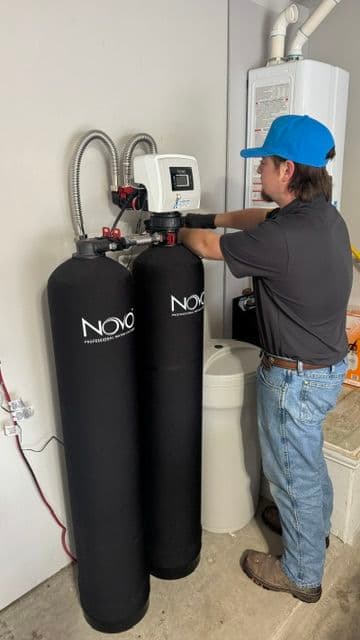
Novo HTO
This system combines:
Water softening
Carbon filtration
The softener removes hardness minerals.
The carbon filtration helps reduce:
Chlorine
Chloramines
Other water treatment chemicals
Together, they provide comprehensive protection for both the plumbing system and water quality.
Water Softener vs. Water Conditioner: Key Differences
Removes Calcium and Magnesium
Water Softener: Yes. A water softener physically removes the calcium and magnesium minerals responsible for hard water.
Water Conditioner: No. A water conditioner does not remove these minerals. They remain in the water.
Reduces Scale Buildup
Water Softener: Yes. Because the hardness minerals are removed, scale buildup is significantly reduced.
Water Conditioner: Somewhat. A conditioner may help reduce how minerals stick to surfaces, but scale buildup can still occur.
Softer Feeling Water
Water Softener: Yes. Most homeowners notice a significant difference in how the water feels after installing a water softener.
Water Conditioner: Usually not. Since the hardness minerals remain in the water, the water typically still feels hard.
Improves Soap Lather
Water Softener: Yes. Soap and shampoo lather much more easily in softened water.
Water Conditioner: Minimal improvement. Because the minerals remain, soap performance is often similar to untreated hard water.
Reduces White Spots on Dishes and Fixtures
Water Softener: Yes. Removing the minerals greatly reduces spotting on dishes, shower doors, faucets, and fixtures.
Water Conditioner: Limited improvement. White spots and mineral residue are still common because the minerals are still present.
Helps Protect Water Heaters
Water Softener: Yes. By removing hardness minerals, water softeners help reduce sediment and scale buildup inside water heaters.
Water Conditioner: Somewhat. A conditioner may reduce some scale formation but does not eliminate the minerals causing the problem.
Requires Salt
Water Softener: Yes. Traditional water softeners use salt during the regeneration process.
Water Conditioner: No. Most conditioner systems operate without salt.
Best for Very Hard Water
Water Softener: Yes. Water softeners are generally the most effective option for areas with very hard water.
Water Conditioner: Usually not. In areas with extreme hardness levels, many homeowners do not achieve the results they expect from a conditioner.
Best Choice for New Braunfels and San Antonio
Water Softener: Yes. With water hardness levels commonly ranging from 15 to 30 grains per gallon, a water softener typically delivers the best results.
Water Conditioner: Usually not. While a conditioner may provide some benefit, it generally does not perform as well as a true water softener in our area's extremely hard water conditions.
Which System Is Right for You?
If your goal is simply to have some form of treatment and you're opposed to salt-based systems, a conditioner may provide some benefits.
However, if your goal is to:
Eliminate hard water problems
Protect your plumbing system
Reduce scale buildup
Improve water quality
Extend appliance life
a true water softener is usually the better solution for the extremely hard water found throughout New Braunfels, San Antonio, and surrounding communities.
Need Help Choosing the Right Water Treatment System?
Every home is different.
The best solution depends on:
Water hardness
Water chemistry
Household needs
Budget
Long-term goals
At Plunger Pros, we help homeowners understand the pros and cons of each option so they can make an informed decision.
We provide water testing, water softener installation, carbon filtration systems, water treatment evaluations, and plumbing inspections throughout New Braunfels, San Antonio, Schertz, Cibolo, Bulverde, Spring Branch, Canyon Lake, and surrounding communities.
Plunger Pros
Plumbing done the proper way
M45279
(830) 356-2141
Frequently Asked Questions
Does a water conditioner remove hardness minerals?
No. Water conditioners generally alter how minerals behave but do not remove calcium and magnesium from the water.
Does a water softener remove hardness minerals?
Yes. Water softeners physically remove hardness minerals through ion exchange.
Why does my water still feel hard with a conditioner?
Because the hardness minerals remain in the water.
Do water conditioners prevent scale buildup?
They may reduce some scale formation, but they do not eliminate the minerals causing the buildup.
Which is better for New Braunfels hard water?
In most cases, a true water softener performs better because local hardness levels are extremely high.
Do water softeners add a lot of sodium?
No. The amount added is generally very small and often less than many common foods.
Can a water conditioner replace a water softener?
For most homes in our area, homeowners expecting soft-water results are usually happier with a true water softener.
What water treatment system does Plunger Pros recommend?
We commonly recommend a combination water softener and carbon filtration system, such as the Novo HTO, for comprehensive water treatment and plumbing protection.